
The changing role of HR in the digital era
Human Resources is no longer just an administrative function.
In today’s fast-changing business environment, HR plays a strategic role in talent development, workforce planning, and employee experience.
However, many companies are still managing HR operations using Excel spreadsheets, emails, and manual processes — a method that worked in the past but is now becoming a major obstacle to growth.
This is why HR digital transformation has become a priority for modern organizations.
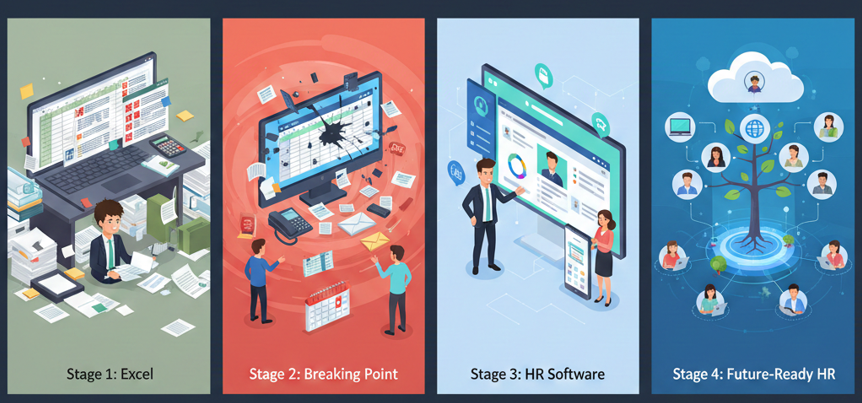
Stage 1: Managing HR with Excel – familiar but risky
Excel is often the first tool companies use to manage HR data because it is:
-
Easy to use
-
Low cost
-
Flexible at the beginning
But as the company grows, Excel quickly shows its limitations:
-
 Data scattered across multiple files
 -
High risk of human error and data inconsistency
-
No real-time updates or access control
-
Time-consuming manual work for HR teams
-
Difficult to generate accurate reports
At this stage, HR teams spend most of their time maintaining data instead of supporting people.
Stage 2: The breaking point – when Excel is no longer enough
Most companies realize they need a better solution when they face problems such as:
-
Payroll errors caused by manual calculations
-
Conflicts around leave balances or overtime records
-
Delays in approvals due to email-based processes
-
Lack of transparency for employees
-
Difficulty scaling HR operations as headcount increases
This is the moment when HR leaders start looking for a more structured, automated, and reliable system.
Stage 3: Transitioning to HR Software
HR software helps companies move from manual management to a centralized and data-driven HR system.
With HR software, organizations can:
-
 Centralize employee data in one secure platform
 -
 Automate time attendance, shifts, leave, and overtime
 -
 Reduce payroll errors and processing time
 -
 Generate real-time HR reports for decision-making
 -
 Improve employee self-service and transparency
Instead of “fixing problems,” HR teams can finally focus on strategy, culture, and employee engagement.
Stage 4: Building a future-ready HR function
Digital HR transformation is not just about replacing Excel.
It’s about creating a scalable HR foundation that supports long-term growth.
A modern HR system enables companies to:
-
Adapt to remote and hybrid work models
-
Improve employee experience
-
Make data-backed people decisions
-
Reduce operational risks
-
Strengthen employer branding
Companies that invest early in HR technology gain a clear competitive advantage in attracting and retaining talent.
The journey from Excel to HR software is a natural step in every growing organization.
The question is not if companies should digitalize HR, but when.
The sooner HR processes are standardized and automated, the faster organizations can unlock the full potential of their people.
 Start your HR digital transformation today
Discover how Talent Solution helps businesses simplify HR operations, improve transparency, and scale with confidence.
 Website: https://talentsolution.app
 Email: contact@talentsolution.app